Last Updated on October 29, 2025 by Sophie Wilesmith
Our MD, Florian Ilias, makes the case for planting perennial energy crops to achieve environmental goals and be a reliable source of income for farmers. He asks the question: If we’re dedicating fields to energy anyway, shouldn’t those crops support our environmental goals rather than work against them?
Two recent UK government reports on the Sustainable Farming Incentive (SFI) scheme and bioenergy crops reveal an important paradox in how Britain manages its agricultural land. While both initiatives remove land from traditional food production, neither has impacted food prices – grain prices remain well below their 10-year average. However, a closer examination suggests the UK may be missing an opportunity for a more integrated approach that could better serve both environmental and energy objectives.
The current situation:
The impact of the SFI:
As of October 2024, 266,100 hectares of UK farmland (3.0% of utilised agricultural area) have been temporarily taken out of production through the Sustainable Farming Incentive scheme. These environmental actions include establishing pollen and nectar flower mixes, winter bird food plots, and grass buffer strips – all designed to support insect and bird populations that have declined due to intensive agriculture.
Energy crop production:
In 2023, 133,000 hectares of UK agricultural land (2.2% of arable land) were used to grow bioenergy crops. Critically, 45,000 hectares of wheat (2.6% of total UK wheat area) were used for bioethanol production, and 73,000 hectares of maize were grown specifically for anaerobic digestion.
The missed opportunity:
Chemical-intensive energy crops:
Most energy crops currently grown in the UK – wheat for bioethanol, sugar beet for biodiesel, and maize for anaerobic digestion – require the same chemical inputs as food crops: pesticides, herbicides, and fertilisers. This creates a contradiction: while the UK pays farmers through SFI to take land out of production specifically to reduce insecticide use and support insect populations, it simultaneously dedicates even more land to chemical-intensive energy crops.
SFI actions target insecticides:
The action covering the most land area in SFI (excluding planning actions) is “No use of insecticide, nematicide, or acaricide on arable crops and permanent crops” (IPM4 and CIPM4), covering 727,800 hectares. The entire premise of these SFI actions is that insecticides harm beneficial insect populations, which in turn reduces food availability for birds. If this premise is correct, why continue growing chemical-intensive energy crops when alternatives exist?
A smarter alternative:
Long-term perennial energy crops:
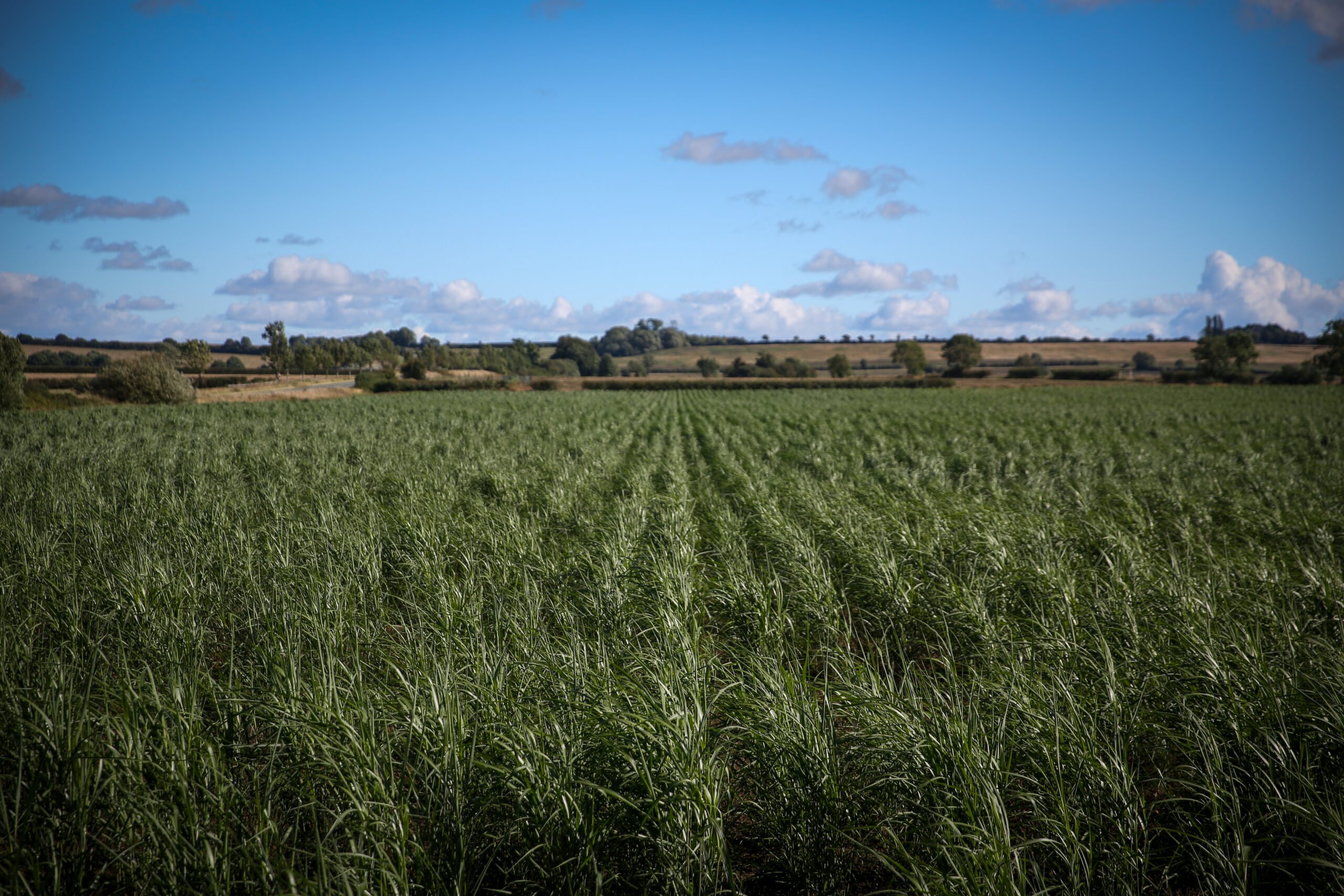
The UK already grows small amounts of perennial energy crops that require minimal or no chemical inputs. 8,800 hectares of Miscanthus and 3,800 hectares of short rotation coppice were grown for biomass energy in 2023.
These crops offer multiple advantages:
- Nitrogen removal: One stated goal of SFI actions is removing excess nitrogen residues from agricultural land – the legacy of decades of fertiliser application. SFI actions achieve this temporarily (typically 3 years). However, perennial energy crops like Miscanthus and short rotation coppice remain productive for 15-20 years, continuously absorbing nitrogen from the soil and providing long-term remediation of over-fertilised land.
- Insect habitat: Unlike annual energy crops that require plowing, pesticides, and herbicides, perennial energy crops create stable habitats. Miscanthus, in particular, provides year-round cover that could support insect populations better than three-year temporary flower mixes.
- Productive use of land: Rather than simply paying farmers to leave land fallow or plant bird food that produces no economic return, perennial energy crops generate income while delivering environmental benefits.
- Reduced chemical use: Miscanthus and short rotation coppice are grown primarily for use in heat and electricity energy markets, burnt in power stations and combined heat and power units, and once established, require virtually no pesticides, herbicides, or fertilisers.
The farm viability crisis:
The erosion of farming profitability:
The UK farming sector faces a perfect storm of economic pressures: recent policy decisions, inheritance tax changes, fertiliser prices that remain elevated following global supply disruptions, grain prices well below historic averages, and declining productivity on marginal land. The cumulative effect is stark—the average UK farm family can no longer survive on farming income alone. Many have diversified into off-farm employment, tourism, or other enterprises just to maintain their holdings.
SFI: A well-intentioned quick fix:
The SFI was designed, in part, to provide economic support to struggling farmers while delivering environmental benefits. However, the reality is more problematic. Most SFI actions do not cover farmers’ actual costs; they provide small annual payments that partially offset lost income from taking land out of production or adopting less intensive practices.
This creates a vicious cycle: farmers receive modest annual subsidies that don’t address their fundamental profitability crisis, push production onto poorer land with higher input costs and lower yields, and gradually see their business margins erode further. Family farms, the bedrock of the UK landscape and the primary caretakers of rural habitats, are slowly being pushed toward insolvency, not despite support schemes, but partially because of how those schemes are structured.
A capital investment alternative:
Would it not be smarter to redirect public resources from ongoing annual subsidy payments toward one-time capital investments in establishing perennial crops? The establishment costs for miscanthus or short rotation coppice are significant; this is the primary barrier to adoption. But once established, these crops provide
- 15-20 years of reliable income without annual replanting costs
- Dramatically reduced input costs (no annual fertiliser, pesticide, or herbicide expenses)
- A predictable, stable revenue stream that supports long-term farm planning
Instead of paying a farmer £200-300 per hectare annually for 3-5 years to maintain a flower margin (which doesn’t solve their profitability problem), the government could provide a £2,000-3,000 per hectare establishment grant for perennial energy crops that would deliver environmental benefits for two decades while creating a genuinely profitable enterprise. This shifts public investment from perpetual life support to genuine economic transformation.
The current approach compounds the farm viability crisis by creating subsidy dependency without addressing underlying profitability. A capital investment model would create resilient farm businesses that don’t require ongoing support, which is surely better for both farmers and taxpayers in the long run.
The policy question:
Resource allocation:
If the objective is to increase insect and bird populations by reducing agricultural chemicals, wouldn’t public resources be better spent replacing chemical-intensive energy crops with perennial alternatives rather than paying farmers to take land out of production entirely?
Consider the numbers: In 2023, 118,000 hectares grew wheat, sugar beet, and maize for energy purposes – nearly as much land as the entire SFI scheme removes from production. If even half of this chemical-intensive energy crop land transitioned to perennial crops like Miscanthus, the UK could:
- Maintain energy production (potentially increasing it, given Miscanthus yields)
- Dramatically reduce pesticide and fertiliser use across tens of thousands of hectares
- Create long-term insect habitat and nitrogen remediation zones
- Reduce the need for compensatory SFI payments to take other land out of production
- Maintain energy production (potentially increasing it, given Miscanthus yields)
- Dramatically reduce pesticide and fertiliser use across tens of thousands of hectares
- Create long-term insect habitat and nitrogen remediation zones
- Reduce the need for compensatory SFI payments to take other land out of production
The economic reality:
The fact that grain prices remain well below their 10-year average despite both SFI land retirement and energy crop production demonstrates that the UK has agricultural capacity to spare. This provides a unique window of opportunity to restructure land use strategically rather than reactively.
Conclusion:
The UK’s current approach treats environmental restoration and energy production as separate, competing demands on agricultural land. A more integrated strategy would recognise that energy crop production could itself deliver environmental benefits, if the right crops are chosen.
By transitioning from annual, chemical-intensive energy crops (wheat, sugar beet, maize) to perennial, low-input alternatives (Miscanthus, short rotation coppice), the UK could:
- Reduce agricultural chemical use across a larger area than SFI currently covers
- Provide 15-20 years of continuous nitrogen remediation rather than 3-year rotations
- Create stable insect and bird habitats while maintaining productive land use
- Free up public funds currently used for SFI payments
The policy question is straightforward: if we’re going to dedicate land to energy production anyway, shouldn’t we choose energy crops that align with, rather than undermine, our environmental objectives? The current data suggests we’re paying twice: once to remove chemicals through SFI, and again to grow chemical-intensive energy crops. A smarter approach would make energy crops part of the environmental solution, not part of the problem.
Source
- https://www.gov.uk/government/statistics/sustainable-farming-incentive-action-uptake-data-october-2024/sustainable-farming-incentive-action-uptake-data-october-2024
- https://www.gov.uk/government/statistics/bioenergy-crops-in-england-and-the-uk-2008-2023/bioenergy-crops-in-england-and-the-uk-2008-2023
- https://tradingeconomics.com/commodity/wheat#:~:text=Historically%2C%20Wheat%20reached%20an%20all,1350.00%20in%20March%20of%202022