

CLICC – Circular low-input carbon crop
Miscanthus – truly clicks
By embracing Miscanthus, industrial biomass users can transition to a low-carbon, resource-efficient economy in which sustainable crops support development without exploiting nature.
CLICCs aim to decouple economic growth from resource consumption, reducing environmental harm and creating a sustainable, end to end circular economy.
This approach doesn’t just mitigate damage; it actively repairs ecosystems while driving innovation and economic resilience.

The 4 R principles of CLICCs
At the heart of every CLICC are the four Rs, powering circularity along the value chain – from soil to system and back to the soil.
- Reduce: Use fewer inputs to grow
- Reuse: Keep biomass in circulation once harvested
- Recycle: Convert residues into new products
- Regenerate: Return nutrients back to the soil

C – Circular by Design
The aim is to keep resources in use for as long as possible, minimise waste, and reuse and recycle materials at the end of their life cycle.
Miscanthus is a perennial crop that regrows every year, thereby reducing soil disruption. Its versatile biomass is used in many different industries and products.
After use, the carbon molecules of the end product return to the soil, fostering new growth.
Miscanthus grown on poor soil is turned into chicken bedding. Once used, the manure is converted into biogas and the remaining digestate is compressed into pellets for use as fertiliser, which ultimately returns to the soil.
LI – Low-input, high-yield
Unlike traditional crops, Miscanthus can thrive without agricultural inputs such as pesticides, fertiliser and fungicides.
Thanks to its deep root system, which efficiently recycles nutrients and prevents soil erosion, it requires no additional inputs once established. Its high biomass yield outperforms that of many conventional crops.
This makes it an ideal solution for less productive fields, as it reduces competition with food production.
Conventional crops grown for energy production (methane, biodiesel, biogas, etc.) require substantial amounts of fertiliser and, in some cases, irrigation. This is not the case for Miscanthus: once planted, it recycles what is available.
CC – Carbon negative crop
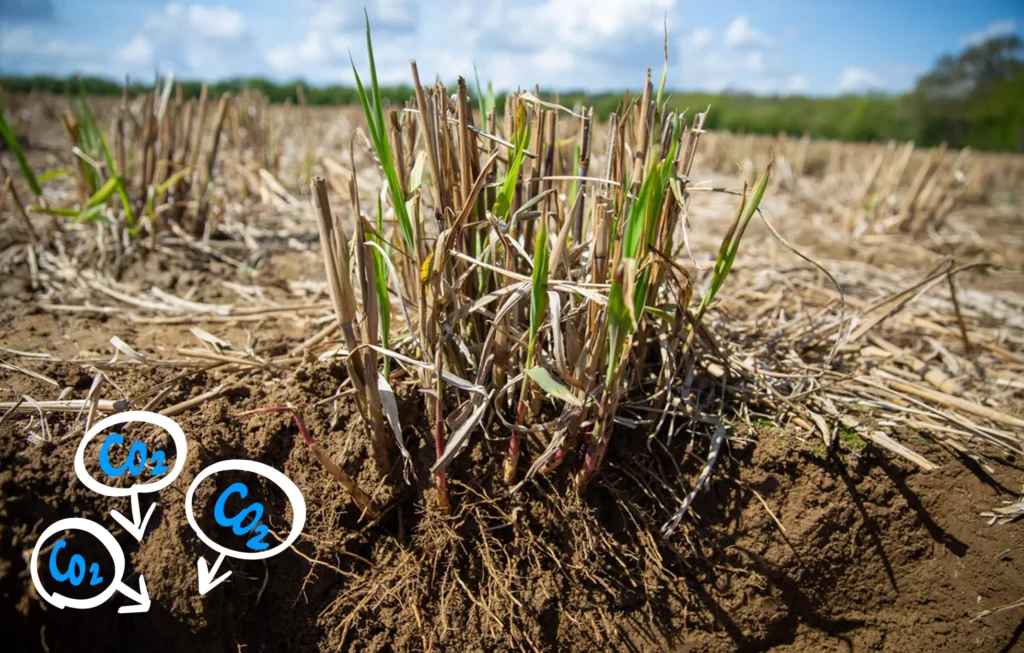
Miscanthus is a powerhouse of carbon sequestration. Its extensive root system traps carbon underground, and its rapid growth absorbs CO₂ from the atmosphere at an impressive rate.
In fact, studies show that Miscanthus can sequester up to 29 tonnes of CO₂ per hectare per year, contributing to an overall net-negative carbon footprint.
Miscanthus stores up to 26 tonnes in the above-ground biomass – which regrows every year – and 3 tonnes in the form of soil carbon, per hectare per year.
Yes, Miscanthus is a CLICC, a circular low-input carbon crop.
Above-ground biomass is used to produce particle boards, which stores CO₂ in kitchens for decades. Miscanthus sheds its leaves in autumn, thereby enriching the soil’s organic content.
CLICCs far outperform traditional energy crops.
They regrow yearly, reducing farmers’ maintenance work, and deliver carbon-negative benefits, all while requiring no inputs and thriving on most fields.
In addition to providing energy, CLICCS can be used to produce bio-materials, construction materials and bio-chemicals, and they offer a wide range of system services that result in greater soil health.

CLICCS
are a smarter
& more sustainable choice.
Continue reading about Miscanthus…

Is Miscanthus really that great?
Find out what Miscanthus can do for you.