Last Updated on December 19, 2025 by Florian
Miscanthus, a perennial energy crop, has gained traction among UK growers for its low-input, high-biomass potential. To better understand the economics of Miscanthus cultivation, a recent survey collected harvest data from multiple growers, detailing tonnage delivered, yield per hectare, costs, and net margins. The survey allows us to quantify both total net margin and net margin per hectare, providing practical insights for prospective and existing Miscanthus growers.
The survey
The dataset comprised six farm entries with harvested areas ranging from 14 to 110 hectares. Key parameters recorded included the number of bales collected, tonnage delivered, yield per hectare, and a range of associated costs, including haulage, cutting, baling, chasing, turning, and storage. Base price per ton was also reported for revenue calculation.
Calculating the net margin
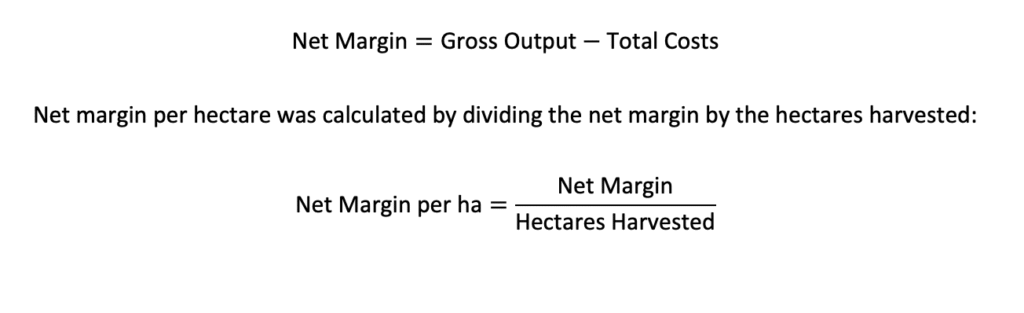
For each farm, gross output was calculated by multiplying delivered tonnage by the base price per ton. Total costs included haulage, cutting, baling, chasing, turning, and storage. The net margin was then calculated as:
Survey data summary
| Yield (t/ha) | Net Margin (£/ha) |
| 3.08 | 195.79 |
| 11.10 | 795.51 |
| 12.65 | 915.89 |
| 10.65 | 804.40 |
| 5.94 | 556.94 |
| 7.37 | 672.77 |
Notes on costs and revenue:
- Costs varied significantly across farms due to differences in haulage distances, baling efficiency, and storage methods.
- Bale rejection or non-collection slightly reduced tonnage delivered but had minor effects on net margins.
- The smaller the area of Miscanthus the higher the contractor’s costs.
Insights and observations
- Net margin variability: Net margins per hectare ranged from £195.79 to £915.89, reflecting differences in yield, scale, and operational efficiency. Farms with higher yields per hectare generally achieved higher profitability.
- Scale effects: A Larger Miscanthus area (e.g., 110 ha) benefited from economies of scale, achieving substantial total net margins (£74,186) while maintaining competitive net margins per hectare (£672.77).
- Yield optimisation matters: Farms with lower yields per hectare but high efficiency in baling and haulage still achieved healthy net margins, highlighting the importance of operational management.
Conclusion
The survey highlights that Miscanthus cultivation can be economically viable, particularly when operational efficiencies are maximised and yields are optimised. Net margins vary widely depending on farm size, yield, and cost management, emphasising the need for growers to carefully plan harvest logistics, storage, and bale management.
For growers evaluating Miscanthus, this data demonstrates the potential for both profitable small-scale operations and highly lucrative large-scale cultivation, provided cost control and yield optimisation are prioritised.
Terravesta intends to extend this survey to more growers, and those who share their costs will receive input on how to improve returns.