Last Updated on September 22, 2026 by Sophie Wilesmith
New research highlights the economic, operational and environmental benefits of Miscanthus, while demonstrating why a whole-farm approach is essential when assessing its potential.
For farmers considering alternative income streams, the financial case for any new crop needs to be clear. With volatile commodity markets, rising production costs and increasing pressure to improve environmental performance, bioenergy crops offer an opportunity to diversify farm businesses and make better use of land.
However, comparing crops based solely on their immediate per-hectare return can overlook the wider contribution they make to the farm.
A new study by Toby Russon, Evaluating the Case for Bioenergy Cropping: A Mixed-Methods Study of AD Maize and Miscanthus in Lincolnshire, explores the economic, agronomic and environmental differences between AD maize and Miscanthus. While the research identifies a higher direct net margin for maize within its model, it also highlights the operational efficiency of Miscanthus, its carbon benefits and the wider value it can bring to farm businesses.
For growers considering long-term diversification, the findings provide useful insight into where Miscanthus fits, and why the way returns are calculated matters.
Understanding the financial returns
The study compares a composite baseline for AD maize with two Miscanthus genotypes: the established Miscanthus × giganteus (MxG) and the newer Terravesta Athena hybrid.
The financial modelling includes input costs, operational costs, rent and overheads. For Miscanthus, it also accounts for the cost of establishment projected over the productive life of the crop.
The results are as follows:
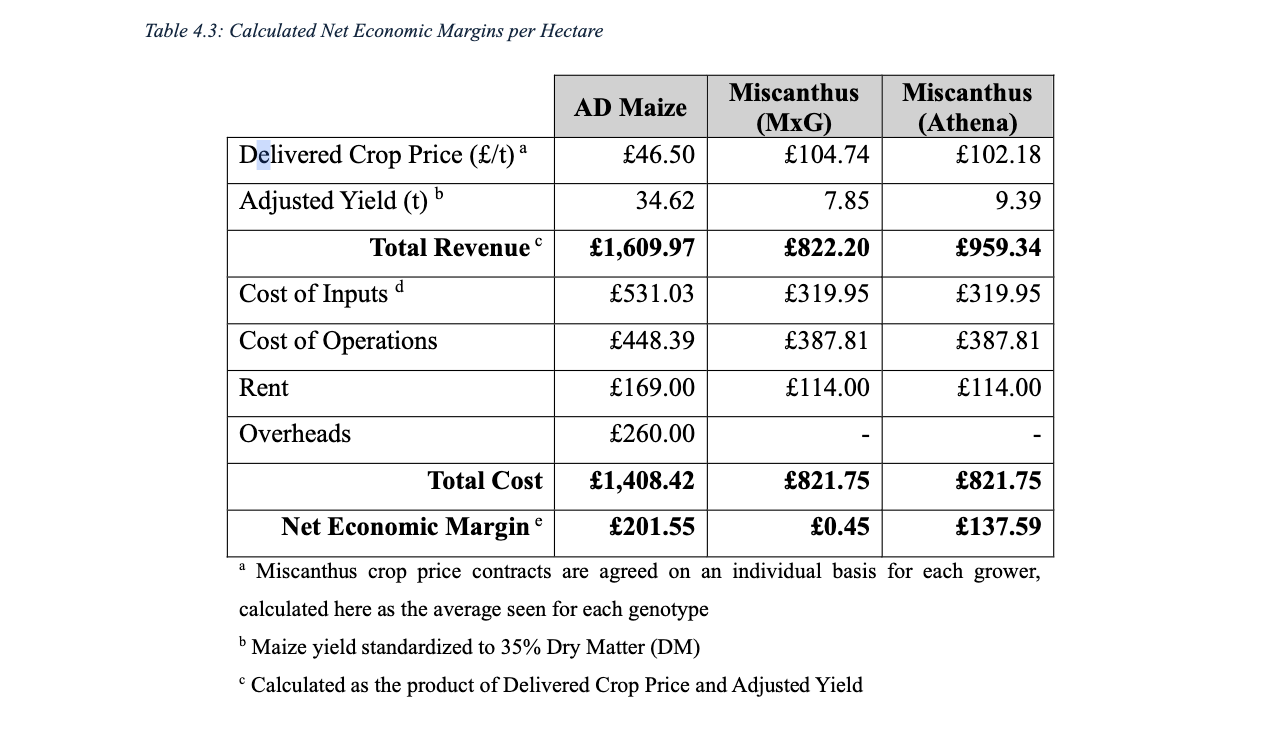

Source: Russon (2026), Table 4.3. Figures are based on the study’s composite model and should not be treated as guaranteed returns.
The model shows that maize generates the highest direct net margin at £201.55/ha, but Terravesta Athena offers better value for money because it produces a higher percentage return on the money invested.
With the same modelled costs, Athena’s higher yield produces a net economic margin of £137.59/ha, compared with almost break-even returns for MxG. It therefore highlights the importance of considering variety performance, establishment and crop management when assessing the potential of Miscanthus.
The study uses average contract prices and modelled assumptions. Actual returns will depend on factors including land suitability, establishment costs, crop yield, harvesting arrangements, transport, contract terms and the availability of an appropriate end market.
Terravesta Athena
One of the key findings is the performance of Terravesta Athena compared with the established MxG genotype.
Terravesta Athena produces around 39,400 kWh of energy per hectare, almost matching the 40,200 kWh produced by maize. This means Athena delivers approximately 98% of maize’s energy output, while costing less to produce.
| Energy production measure | AD maize | MxG Miscanthus | Athena Miscanthus |
| Energy yield | 40,156.62kWh/ha | 32,951.15kWh/ha | 39,411.05kWh/ha |
| Levelised cost of energy | 3.51p/kWh | 2.49p/kWh | 2.09p/kWh |
The modelled cost per unit of energy for Terravesta Athena is 2.09p/kWh, compared with 3.51p/kWh for maize. According to the study, maize is therefore 67.9% more expensive per unit of energy produced than Athena in this comparison.
This distinction is important. Although the landowner’s direct margin is only one part of a cropping decision, the cost of producing energy helps demonstrate the efficiency of the feedstock itself.
A lower-input crop with a different management profile
Miscanthus is a perennial crop, meaning that once established it can be harvested annually without the need for yearly cultivation and establishment.
Its deep root system, perennial growth habit and nutrient-use efficiency contribute to its ability to produce biomass with low ongoing input requirements. The crop’s dense canopy can also suppress and outcompete weeds, while nutrients such as nitrogen and potassium are translocated back into the rhizomes during senescence.
For farmers, this offers a different management model from annual cropping.
Miscanthus can be grown on land where achieving consistent cereal yields may be challenging, allowing the farm business to concentrate inputs and management on its most productive areas. The study describes this as a land-sparing approach: allocating poorer-performing land to biomass production while focusing food-crop production on land with greater yield potential.
The benefit is not necessarily that every hectare of Miscanthus will outperform every alternative crop. Rather, the value may lie in how it changes the performance and workload of the farm as a whole.
Why the whole-farm return matters
The study argues that conventional crop margins can fail to capture some of the wider costs and benefits associated with bioenergy cropping.
For maize, interviewees highlighted the value of digestate as a nutrient source and soil improver, as well as its role within the wider farm rotation. However, the research also identified concerns around soil compaction, track damage, logistics, machinery wear and the impact of harvesting conditions on subsequent crops.
These costs may not always be allocated directly to the maize farming.
Miscanthus presents a different set of considerations. Establishment requires significant upfront investment, and the perennial nature of the crop limits the ability to change land use from year to year. The study also identifies the opportunity cost of alternative land uses, including agri-environment schemes, as an important factor when assessing the crop’s suitability.
At the same time, Miscanthus can offer strategic benefits by taking consistently underperforming land out of intensive annual cropping. This may allow farmers to:
- Concentrate fertiliser, machinery and management on higher-performing land.
- Reduce the risk of chasing low or inconsistent yields on difficult areas.
- Generate income from land that may be less suited to conventional cropping.
- Spread workloads through the year, with operations taking place outside some of the busiest periods for food crops.
- Establish permanent vegetation that can provide environmental benefits in appropriate locations, including along watercourses.
These benefits will vary from farm to farm and should be assessed alongside the potential loss of other income, including grazing or scheme payments. Nevertheless, they demonstrate why a whole-farm assessment can provide a more complete picture than an isolated gross margin.
Carbon efficiency
The environmental findings are one of the clearest areas in which Miscanthus outperforms maize in the study.
The modelled net carbon balance for maize is 3.77tCO₂e/ha, compared with 0.32tCO₂e/ha for Miscanthus. The study attributes Miscanthus’s near-neutral balance to carbon uptake during growth and the accumulation of carbon within soil organic carbon.
Athena also records a modelled carbon intensity of 8.12kgCO₂e/MWh, compared with 93.88kgCO₂e/MWh for maize, a reduction of approximately 91%.
The study calculates a negative marginal abatement cost for Miscanthus Athena of -£49.46/tCO₂e. In the context of the report, this indicates that the crop provides emissions reductions at a net economic saving compared with the fossil-fuel baseline used in the model.
However, the research highlights a significant challenge: the environmental value of Miscanthus is not currently fully reflected in the return received by the farmer.
Where carbon sequestration and other environmental benefits are not financially rewarded, growers are likely to base their decisions primarily on the direct income available through the crop contract. The study therefore argues that future market mechanisms need to provide a clearer route for growers to benefit from the carbon value generated by perennial biomass crops.
Security and stability are part of the return
For many farm businesses, the attraction of a bioenergy crop is not simply the potential margin per hectare. It is also the opportunity to establish a more predictable income stream outside volatile commodity markets.
The study’s interviews found that profitability and stability were the most influential factors in land-use decisions, accounting for 57% of the weighted influence in the research. Environmental impact accounted for a smaller proportion.
This is an important consideration for Miscanthus, given the long-term commitment involved. Establishment costs are incurred at the beginning of the crop’s life, while the farmer commits land to a perennial system for many years.
A long-term contract with a dependable end market can help address some of these concerns. For the grower, the decision involves weighing the loss of annual cropping flexibility against the potential for stable income, reduced management requirements and diversification away from traditional commodity markets.
As with any long-term agreement, the report suggests terms need to be examined carefully, including pricing, indexation, establishment arrangements, harvesting responsibilities, transport and the conditions governing the end of the contract.
A long-term opportunity
Miscanthus is often associated with lower-grade or marginal land, but the study suggests that the crop should instead be considered as part of a strategic whole-farm approach.
For some businesses, its value may come from producing biomass efficiently on land that struggles to deliver consistent returns from annual crops. For others, it may offer a way to reduce management intensity, spread workloads and establish a long-term contracted income stream.
Terravesta Athena’s performance also demonstrates the importance of continued improvement in planting, establishment and crop management. The report notes that practical knowledge of establishment and growing techniques may have contributed significantly to yield improvements, meaning that performance differences should not automatically be attributed solely to genotype.
The financial model provides a useful starting point, but it is not a farm-specific budget. Growers should assess their own land, contract terms, establishment package and alternative cropping opportunities before making a decision.
The case for Miscanthus is therefore about more than its return per hectare. It is about how a perennial biomass crop can contribute to farm resilience, operational efficiency and long-term diversification, while creating the potential for environmental value to become a more visible part of the farm business.