Last Updated on September 22, 2026 by Sophie Wilesmith
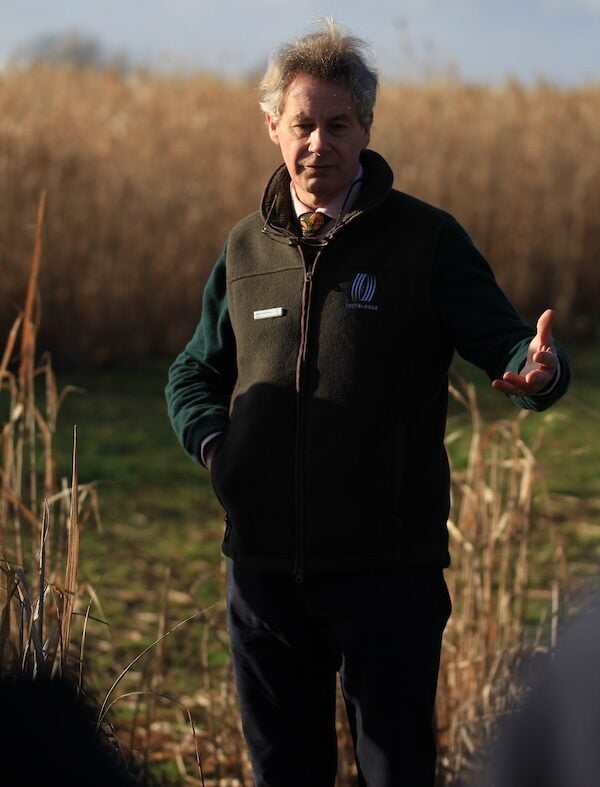
For William Cracroft-Eley, Miscanthus started as a way to generate a reliable return from difficult-to-farm land. Two decades on, the crop has become an important part of a wider transformation of his farm business, helping to reduce risk, lower working capital requirements and focus arable production on the land best suited to it.
When William Cracroft-Eley first planted Miscanthus in 2006, the decision was driven by a straightforward commercial consideration: how to generate a low-input, lower-risk return from land that presented challenges for conventional arable production.
At the time, cereal prices were below £100/t, and Miscanthus offered an alternative for high-risk land. Twenty years later, with 122ha of Miscanthus established across the farm, William believes the crop has demonstrated its value in some of the most difficult conditions faced by the business.
“Miscanthus offered a low input and low risk return, as a perennial crop on high risk, difficult to farm land,” he explains. “Today, the cereal margins are, in reality, no better than back in the early 2000s.”
Building experience and expanding the area
William’s Miscanthus journey began with the establishment of 60ha of Miscanthus × giganteus in 2006, 2007 and 2013. A further 62ha of Terravesta Athena was planted from 2014 onwards.
As an early adopter, he acknowledges that the farm made mistakes during the initial establishment of the crop. However, those experiences have helped inform ongoing improvements in crop management.
“We made plenty of mistakes, and it has been both our own and Terravesta’s mission to continually improve Miscanthus genetics and agronomy ever since,” says William.
That experience has contributed to a better understanding of how to establish and manage the crop, giving William the confidence to expand the area planted. He has approximately doubled his original planting area, including renting land specifically for Miscanthus.
The crop now plays a role beyond simply generating an income from individual fields. William says it has added certainty to the farm business.
“From the farm business perspective it has reduced my working capital requirement and enabled some long-term restructuring in terms of labour and machinery,” he says.
Miscanthus has also contributed to a reduction in the farm’s carbon footprint, which William believes could deliver additional financial benefits in the future, either through emissions trading or by helping to avoid emissions-related costs.
Matching the crop to the land
The farm includes three main soil types: limestone brash, sand and clay. Miscanthus has predominantly been established on the clay and an area of impervious limestone, while cereals, in rotation with outdoor pigs, are concentrated on the limestone brash and sand.
Rather than trying to grow cereals across all available land, William has used Miscanthus to remove fields that were difficult or inefficient to farm from the arable area.
These have included land that is:
- Too wet or too dry.
- Too stony.
- An awkward shape.
- Affected by herbicide resistance.
- Difficult to manage efficiently within the arable system.
Miscanthus has been planted across whole fields and, in some cases, parts of fields. This has enabled the farm to focus its arable production on the easier-to-farm soils, helping to improve efficiency and simplify the wider farming operation.
“We haven’t yet used it rotationally, as the only field so far taken out of Miscanthus giganteus has been replanted with Terravesta Athena,” William explains. “We have used it on fields that were a problem for a number of reasons.”
The farm’s machinery strategy has also changed significantly. It no longer owns its own arable machinery, apart from a share in a combine, with the remaining operations carried out by a neighbouring farm under a stubble-to-stubble contract.
Miscanthus has been part of the process that enabled William to reconsider how the farm uses its land, labour and machinery.
From an all-arable approach to a more dynamic system
Looking back over the past 20 years, William says the farm has changed considerably, particularly during the last decade. Miscanthus has not been the only driver of change, but it has helped facilitate the process by providing a viable alternative to conventional arable production.
“Twenty years ago we were ‘anything that goes through a combine’,” he says. “Miscanthus, and subsequently also SFI, gave us an option to critically appraise the viability of our land for arable enterprises by offering a strong alternative.”
The decision to plant Miscanthus provided an opportunity to assess the performance of individual fields more critically. Instead of continuing to farm land simply because it had traditionally been used for arable production, William could consider whether it was delivering a sustainable return.
For William, the comparison is particularly clear in difficult cereal years.
“We could see that in a bad year cereals lose us money, whereas Miscanthus is always positive, even if some years are more so than others,” he says.
The effect of this and last year’s climate is very variable. The best 35ha, on a river flood plain, is relatively unaffected, and looks very well. I would expect this to yield in the mid teens t/ha. On the rest of my fields, the Terravesta Athena is probably 70cm lower than normal, and the giganteus (which is both older and on the most drought prone areas) a bit worse,” he says.
“Looking at other crops as I go around the country, those north of the Humber and west of the Pennines seem to be generally quite good. Those in parts of Lincolnshire and East Anglia seem to have suffered more but should still deliver a worthwhile harvestable yield.”
Resilience during challenging growing seasons
The past two years have highlighted the financial risks associated with cereal production. Prolonged dry conditions have had a severe impact on the farm’s cereal yields, with production falling well below the level required to break even.
Lower straw yields have added to the pressure, particularly because straw is needed for bedding. William says the situation could also create an opportunity for Miscanthus in the future, given its potential as an alternative source of bedding material.
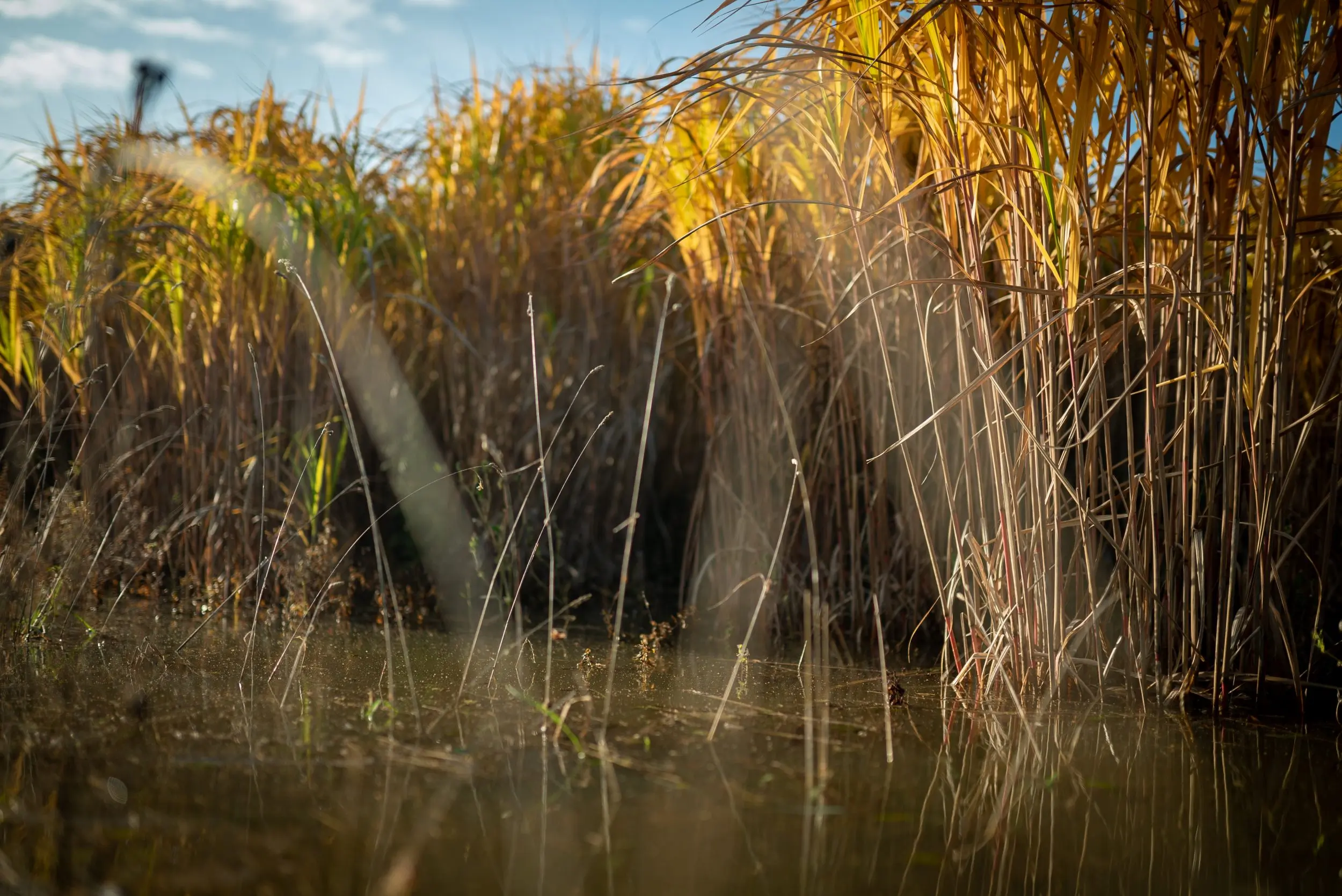
The Miscanthus crop has not been unaffected by the dry conditions. William reports that drought has had an impact. However, the cost structure of the perennial crop means that it continues to provide a return at harvest, even when yields are reduced.
“The Miscanthus has been hit by the recent drought, but it will yield a net revenue at harvest because, unlike cereals, it has incurred no annual cost other than the harvest itself.”
For William, this is where the value of Miscanthus becomes most apparent. The crop provides an established perennial system with limited annual input requirements, helping to protect the farm from some of the cost exposure associated with annual cropping.
“It is in these truly marginal circumstances that it comes into its own,” he adds.